Thursday, 30 April 2015

autonomous extraction system for cars


https://www.youtube.com/watch?v=QXSJ7dprzf4

An Autonomous Multi-Robot System for Vehicle Extraction and Transportation is the result of the AVERT project research resulting from a collaboration between researchers from Greece, Germany, Switzerland and the UK. the idea behind this is that the current solutions for car removals within confined spaces like indoor parking lots where space is at a premium and there is no room for maneuvering towing trucks or equipment they have come up with a solution to remove cars in confined spaces safely, swiftly and in any direction to a safer disposal point. this technology also could be used in bomb disposal by providing a faster and safer removal capability of suspect cars compared to manual methods currently available.
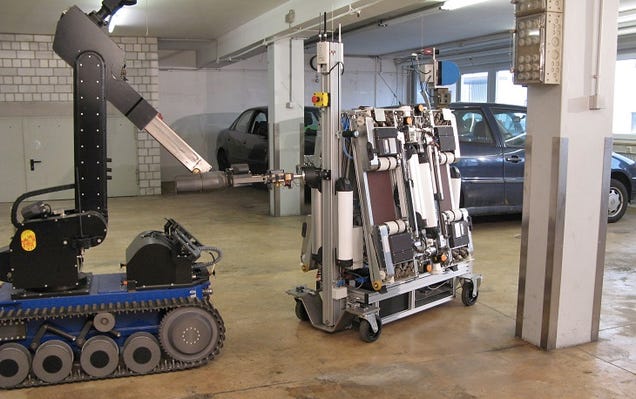


how it works: the deployment unit as seen above is used to transport the bogie units to the operating point, when the bogies are released the deployment unit then starts to map out the area using on board sensors which include two SICK laser sensors, a Pan tilt Unit(PTU) and a digital camera.the bogie subsystem includes the sensors and actuators which provide the mobile docking and vehicle lifting mechanism for each of the four wheels. the bogie units have intercommunication which enables them to operate as a coordinated group of robots in synchronism  when lifting and extracting the vehicle.

 by David Walsh

Wednesday, 29 April 2015

3D prosthetic arms

Over 3000 years ago to Ancient Egypt, people thought that our live have finite length, but the after live is eternal so according to the theology of Orisis, the body needed to be complete, because the soul would leave the body every night and come back to replenish its energy in the body and it was extremely important that body be fully complete. There are many instances of prosthetic noses, ears, toes and limbs which were used in Encient Egypt but they were not functional. Hence prosthetic developed from simply being aesthetic aids to actually becoming functional in everyday life. Globally there are 3 million people living without a upper limb. In last 20 years there are remarkable advancement in the development of the bionic limb.

The huge problem with the bionic limbs is the cost, not everybody can afford $20,000 to $100,000 for an prosthetic limb as you are aware that the wealth is unevenly distributed in the world. UCF is bulding an arm which can be used and manufactured much cheaper equivalent to 1% of the actual cost. The arm is completely 3D printed along with the joints between the fingers. There is a cable which runs through the length of each finger and back into the hand which is connected upto servo motor. The idea is to  trigger the motor by the arm of the person who's wearing it. Therefore the person would wear 3 electrodes on their upper arm. When the person who's wearing the arm squeezes their muscle there's little electrical pulse which triggers the motor to pull in 180 degrees. One pulse will close the hand and the other pulse will relax it so that it can open back up.


3D is new tchnology but it provides the low cost solution to print something out and redesign it and print out again. Today the bionic limb can be produced in just $300, thanks to Chuk Hull who invented the 3D prnting. The arm needs to replaced every 6 moths since kids grows, the parts of the arm can be produce on the spot with the advantage of selecting any design. Its amazing how Chuck Hull made things easy and cheaper that everybody can afford it.


By Ayesha Javaid.


It's called a Memristor?

So how exactly does a Memristor work?


Well an analogy that't there for a Memristor is that of a pipe that carries water.
The water itself is analogous to electrical charge, the pressure at the input of the pipe is similar to voltage, and the rate of flow of the water through the pipe is like electrical current. 

Just as with an electrical resistor, the flow of water through the pipe is faster if the pipe is shorter and/or it has a larger diameter. An analogy for a memristor is an interesting kind of pipe that expands or shrinks when water flows through it.  

If water flows through the pipe in one direction, the diameter of the pipe increases, thus enabling the water to flow faster. If water flows through the pipe in the opposite direction, the diameter of the pipe decreases, thus slowing down the flow of water. 

If the water pressure is turned off, the pipe will retain it most recent diameter until the water is turned back on. Thus, the pipe does not store water like a bucket (or a capacitor) – it remembers how much water flowed through it.


Technically though how does it work?

A Memristor is composed of a thin (50 nm) titanium dioxide film between two 5 nm thick electrodes, one titanium, the other platinum. 


Initially, there are two layers to the titanium dioxide film, one of which has a slight depletion of oxygen atoms. 
     The oxygen vacancies act as charge carriers, meaning that the depleted layer has a much lower resistance than the non-depleted layer. When an electric field is applied, the oxygen vacancies drift towards the non-depleted layer, changing the boundary between the high-resistance and low-resistance layers. causing the low-resistance area to grow and high-resistance area to shrink, lowering the resistance of the device 
     Thus the resistance of the film as a whole is dependent on how much charge has been passed through it in a particular direction, which is reversible by changing the direction of current, when this happens the oxygen vacancies are pushed back up to the top electrode, meaning the boundary has been pushed up creating a greater area of high resistance. 


Shown Below is a sample video explaining the memristor.


By Padraigh Walsh

Asimo now

Ever since asimo was introduced to the world nearly 15 years ago now.It has captured that words imagination. Asimo can now do incredible things from running, going up stairs playing football and many more awesome ability's.The most recent version of asimo was in 2014. here is a video of what he can do now
https://www.youtube.com/watch?v=lrUOa6p5NEI
Even though all these ability's are great. what I believe to be its greatest strength is the ability to communicate with humans.He has even meet  president barrack Obama during a recent state visit to Japan he had an encounter with a Honda he met asimo at the Tokyo's museum of science
Obama describe asimo as '' a little scary'' '' too lifelike'' and '' amazing''


By Hayden Smith 


references
http://www.leftlanenews.com/obama-meets-hondas-asimo-receives-soccer-pass.html
 

From Frog Legs to Your Legs: Electronic Muscle Stimulation

From Frog Legs to Your Legs: Electronic Muscle Stimulation


Electronic muscle stimulation (EMS)
Is a process that involves the use of a particular device to stimulate the contraction of the muscles using electrical impulses. The low-level electronic pulses that are sent to the muscles are meant to halt atrophy or reduce spasms. The process is mainly used in hospitals and physical therapy clinics, but has now found favour among commercial fitness enthusiasts. The history of EMS and how it grew and gained the popularity it now enjoys is quite interesting.

History of Electronic Muscle Stimulation
The journey from a simple discovery through to a well-established theory on electrical impulses and their effects on the body’s process is a very interesting one. It is a story that shows the steady development of the process through scientific discovery as scientist from one century to another made their discovery that contributed to what we now know today.

Electricity was first used as a treatment in 2500B.C which was the time of the Egyptian Fifth Dynasty. The Egyptians found a fish that gave off electric energy and realized it could be used to treat pain. They did not know the force of energy as electricity as we know it now, but they realized its usefulness.


The First Scientific Proof
Italian scientist (Luigi Galvani) made the connection between the muscle and electrical impulses when his assistant accidentally used a scalpel to brush the sciatic nerve of a frog on which they had just done an experiment. The legs of the frog moved as if it was still alive and that caught the attention of Luigi. The year was 1791 and the physiologist provided the first scientific proof that the muscle can be activated by current.

Benefits of Electronic Muscle Stimulation
Electrotherapy is now mainly used in areas that relate to physical and sports activities where muscle injuries are common and rehabilitation is necessary. It is not only used for rehabilitation, but also for training and recovery. People who suffer from debilitating injuries to the skeletal or nervous system and are unable to move their muscles are in danger of muscle atrophy. This is due to the fact that when muscles do not contract they go through a natural deterioration process. People suffering from those types of injuries have to undergo consistent electrotherapy treatment to save the muscles from atrophy. Patients who are critically ill can wear electrical muscle stimulators to help preserve their muscle mass.

Electronic muscle stimulation has Electronic muscle stimulation has moved on from the frog leg to our legs in a very significant way. Many people benefit from the treatment method that started out with the jerk of a dead frog’s leg. The treatment method and electronic muscle stimulator devices are now widely used to assist people in a number of ways. While the treatment is effective and produces great results as is the case with all medical situations, it is best not to go about it on your own impulse.


By: AbdulRahman Mandourah

Tuesday, 28 April 2015

Behind the Notes of Ada Lovelace - Note G

This note is by far one of the most intriguing, however it is not of the longest in length. From Note A, this machine had capability of tabulating any function that may ever exist. This was considered by some as perhaps an "intelligent" machine. It was common at the time to overestimate new inventions or subjects, yet underestimate the true value. The note contains a statement on what we know today as Artificial Intelligence (AI).
"The Analytical Engine has to pretensions whatever to originate anything. It can do whatever we know how to order it to perform. It can follow analysis; but it has no power of anticipating any analytical relations or truths." [1]
This sets straight the proposal for AI, however it is very curious how that subject of AI arose nearly 200 years ago. A few key areas of the writings are below.

Note G
The machine could do the following list of functions:

1. Perform the four operations of simple arithmetic (plus, minus, divide, multiply) on any      numbers.
2. Combine any magnitude or quantity of numbers either arithmetically or algebraically
3. Use algebraic signs according to their proper laws, and develop logical consequences to a calculation
4. Arbitrarily swap and substitute any one formula for another,
5. Provide for singular values. M. Menabrea mentions the passing of values through zero and infinity.
6. Differentiate and Integrate

Numbers four and five as listed above could result in the substitution of   
(\frac{1}{2}\cos\overline{n+1}\theta+\frac{1}{2}\cos\overline{n-1}\theta) for (\cos n\theta\cdot\cos\theta), explained in Note E.

Perhaps the most heavyweight function is the calculus operations of integrating and differentiating. 
The engine could perform this of two ways; either by the user ordering it, or by doing so from any of the columns of variables, by direct substitution. 

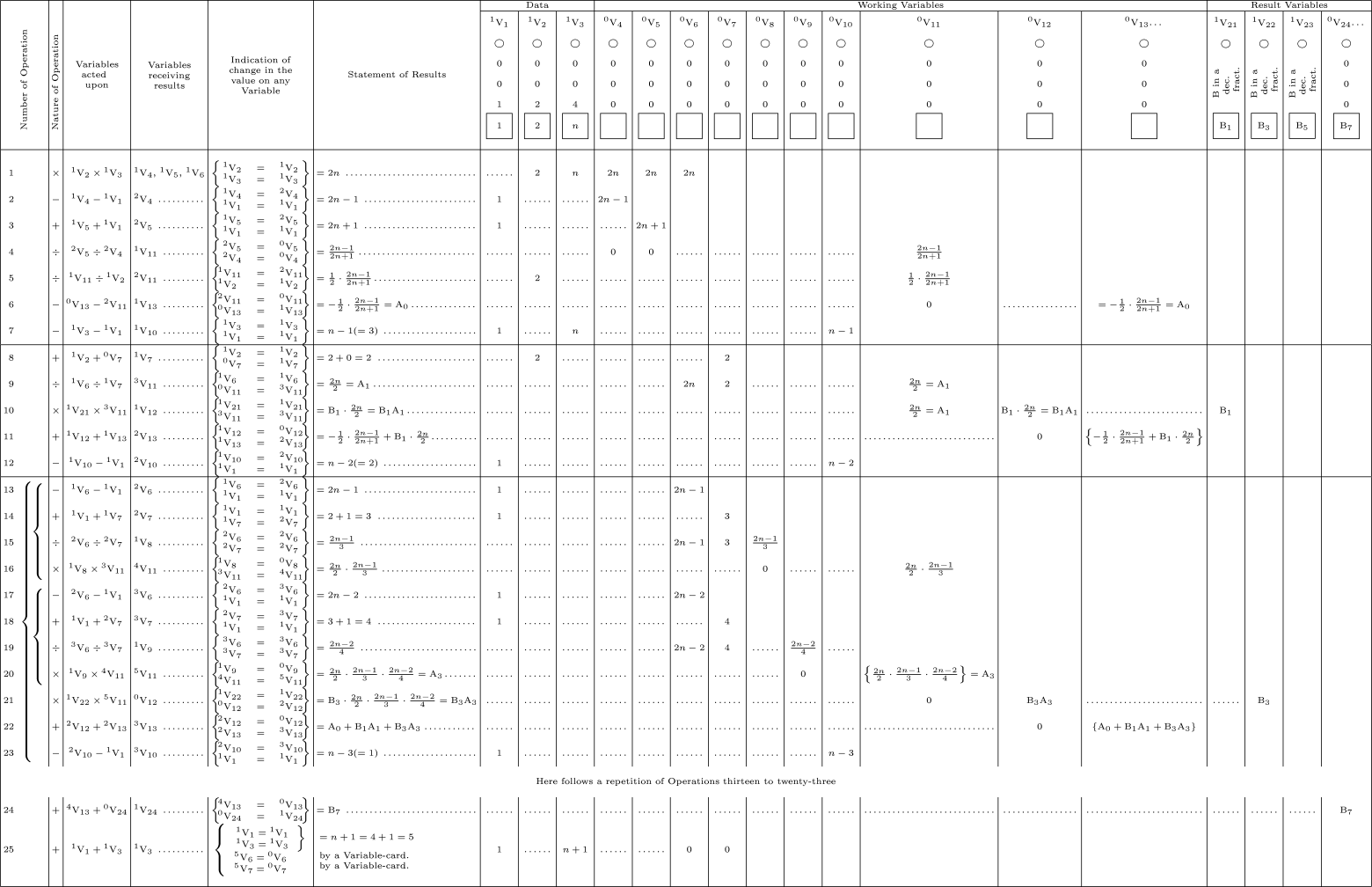
The diagram of the computation of the Bernoulli numbers is very large and intricate as seen above! 
The above diagram may be viewed larger here. 

The note also goes onto describe how the program reads and operates based on the cards entered.  A card could be used to simply change the sign of a number, to producing outputs to complex formulas.  [2] 

In summary of these notes, the program could perform highly complex tabulation of data. It could also calculate the answers from simple equations to integration and differentiation of any degree of trouble! This was an amazing program, which sadly never ran on the machine it was built for. The notes Lovelace kept about the machine and the program allow mathematics and engineering enthusiasts today to investigate her work further. This was a truly inspiring set of work done by Lovelace and Babbage, which computers today are still carrying on from!

By Sophie Wicks

References 
[1] http://www.allonrobots.com/ada-lovelace.html
[2] http://www.fourmilab.ch/babbage/sketch.html

The First "Skype"


This machine in not part of a sci-fi movie from the 60’s, it was actually a great invention by Bell Labs, but probably too well-ahead for its generation. The name of this piece from the past is Picturephone and it was developed by AT&T in 1964 as an experimental system. It was realized at the New York World’s Fair allowing the public make video-calls to Disneyland even before the parents of “Skype” were born.

The system was able to transmit an image only once every two seconds, but this was not a problem for an enthusiastic team neither was that it turned out people didn’t like it, so AT&T continued working on the developing of the system, totally convinced that it was viable. Six years later, they realized the final product hoping that a million Picturephones would be used by 1980. 

It is said that we also learn from our failures, and I am sure they learnt from this one. Do you want to know why not many know about this? The equipment was too bulky, the controls too unfriendly, and the picture too small, and after 6 years improving the system, it continued being the same. Other fact to be aware of was the excessive price of the video-calls, it could cost around $16-$27 just for 3 minutes.

Anyway, we just had to wait to decades to see how communications could change. Nowadays internet is everywhere and we have a “Picturephone” in our pocket, and this is just one of the many things we can do with our smartphone! What years ago looked useless for many people is today an essential tool for others, thanks to the developments in different fields working together. In this case, it was not that crazy to think about what we enjoy today some decades ago, it is just that the idea needed more time to be working better and more science to make it viable.


Sources and interesting links: 
The First 'Picturephone' for Video Chatting Was a Colossal Failure
Video Conferencing History
The History of Videocalling  
 Wikipedia LINK
 by Carlos Durango, 2015